
Categories
2026 real estate forecast - Houston Metro Area, hispanic homebuyers, Home Buying Strategies, House Value, Housing Market, houston real estate, Luxury, Military & Veteran Real EstatePublished November 1, 2026
The Hidden Bill: What It Really Costs to Own a Home in Houston

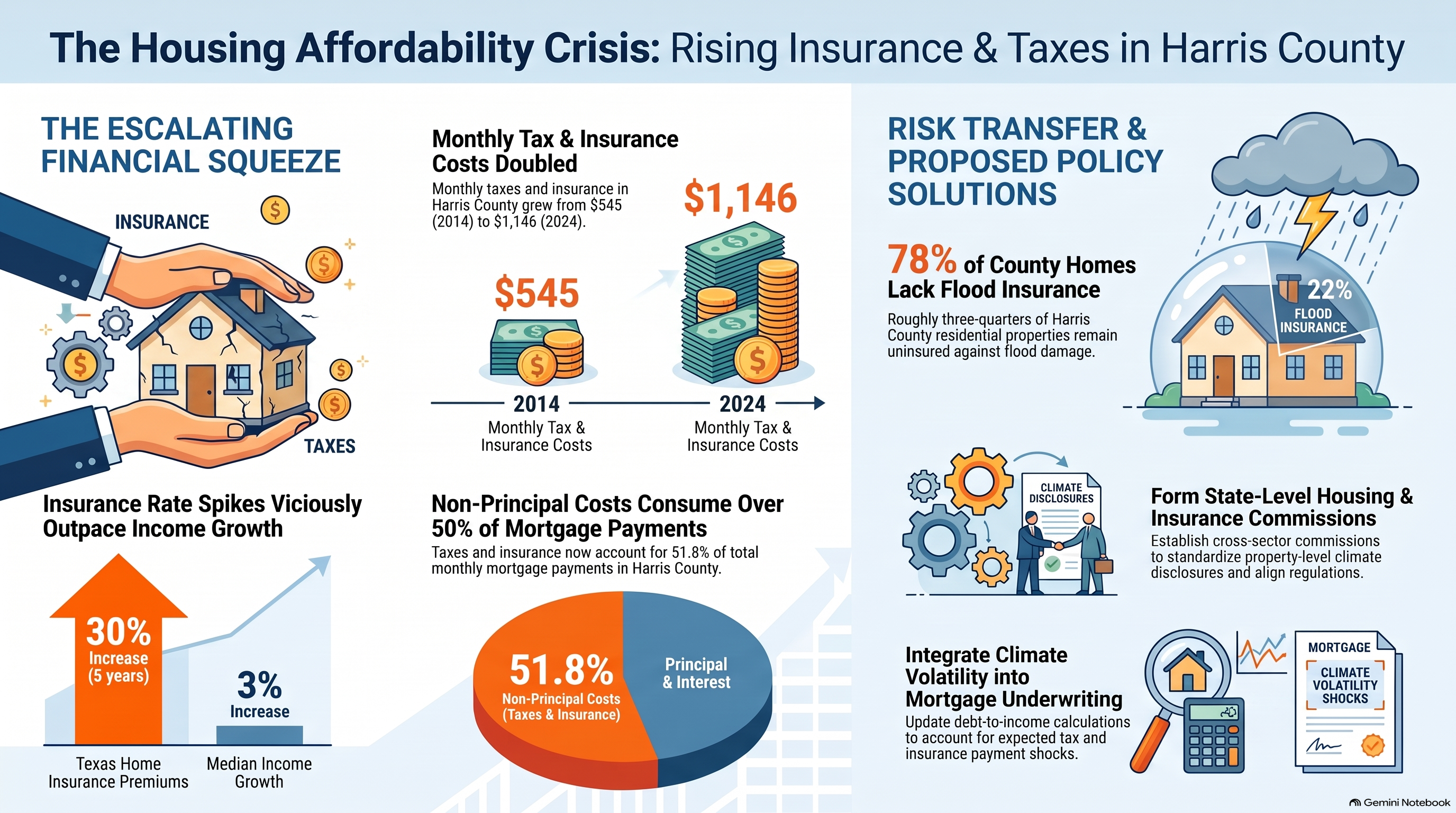
You move to Houston for a better opportunity. You find a house you can afford. You lock in a fixed mortgage rate. Then, a year later, your payment goes up.
Nobody added a bedroom. The interest rate didn't change. So why is more money leaving your account?
The purchase price gets all the attention. The cost of keeping the home is what stays with you, every month, every year. This is the conversation most people skip, and most agents don't want to have. Let's open the entire bill: taxes, insurance, flood coverage, deductibles and commute.
One note before we start: any dollar figures below labeled as examples are illustrations, not quotes or forecasts. Get real numbers for the real address.
Start with your life, not the listing photos
Houston offers real opportunity. The Texas Medical Center alone is the largest medical complex in the world, with more than 100,000 people working there. But a major job center doesn't make every address equally convenient.
A nurse starting a 7 a.m. shift and a remote worker with flexible hours need very different homes. Before you rank houses, rank the daily obligations your address must support:
- Where you work, and how many days you must go in
- Where your kids will be during the workday
- Where the people you depend on live (parents, childcare, family)
- Grocery stores, hospitals, schools and everyday shopping
Map those points first. A pretty house in the wrong spot doesn't become the opportunity you moved here for.
A fixed rate is not a fixed payment
A standard fixed-rate loan keeps your principal and interest steady. That's only one part of the payment. Property taxes and homeowners insurance are usually collected through an escrow account, and when either one rises, your total monthly payment rises with it. The Consumer Financial Protection Bureau makes the same point.
Example (illustration only): Your insurance premium goes up $1,200 a year, or $100 a month. Your escrow is now short. At the annual analysis, the servicer typically collects the shortage and raises the monthly deposit for the higher premium going forward. That can push your payment up by about $200 a month for a while, not $100.
If you already own, read your escrow analysis line by line:
- Identify what caused the increase
- Identify how much is shortage versus the new ongoing amount
- Match the tax and insurance figures against your actual bills
This happened to my own family. We were told our payment would rise $300 a month, $3,600 a year. My wife dug in and found the servicer had charged us twice for homeowners insurance but only paid it once. We disputed it, they corrected it, and our payment didn't go up.
If you're buying, ask exactly which expenses are included in the payment estimate. A low payment built on incomplete assumptions doesn't help you.
Insurance: compare the promise, not just the price
Insurance belongs at the center of the affordability conversation. Rice University's Kinder Institute found that median homeowners insurance in Harris County rose 17% in one year, to about $2,303, in its 2026 State of Housing report. Many families weren't prepared for that.
So don't accept a loan officer's ballpark. Get an actual quote on the actual property from a carrier. Then look past the premium to what the policy promises:
- What happens if the roof is damaged?
- Is wind-driven rain covered? A leaking pipe?
- What exclusions apply?
- Is there loss-of-use coverage if you can't live in the home during repairs?
The Texas Department of Insurance recommends comparing several quotes. Line them up side by side and choose the best coverage, not automatically the cheapest premium. Start early so you can still act during your option period after your offer is accepted.
The 2% deductible that isn't small
"Two percent" sounds harmless. In dollars:
|
Home's insured value |
2% wind/hail deductible |
|---|---|
|
$400,000 |
$8,000 |
|
$500,000 |
$10,000 |
Example (illustration only): Hail damages the roof on a $500,000 home and the claim is approved. The roof costs $20,000. With a 2% deductible, the first $10,000 is yours. You're paying for half a roof, and you have insurance.
Put that deductible next to your cash reserves after closing. If closing wipes out your cushion, a large deductible may not fit your situation. Keep a policy comparison right beside your house comparison: annual premium, key coverages and deductible in dollars.
Property taxes: look up the actual address
There's no single Harris County tax rate. One property can sit inside several taxing units: a school district, the county, a city, a MUD or water district, and other special districts. The bill also depends on taxable value and which exemptions apply to you.
- Ask for the actual taxing units attached to the address
- Ask what taxable value the estimate assumes
- Ask which exemptions or limits are included
The seller's tax bill is useful background, but it isn't automatically the bill you'll inherit. Their exemptions may not be yours.
New construction deserves extra care. Ask whether the tax estimate reflects the finished home or only the lot. A lender may quote a low payment because last year's taxes covered unimproved land. Once the home is assessed, taxes jump, and the payment can climb by hundreds of dollars a month. We see this constantly with new builds.
A lower asking price and a lower total cost are related questions. They are not the same question.
Flood risk: maps are a starting point, not a guarantee
Most homeowners policies don't cover flood damage from rising water. Flood needs its own policy. And being outside a mapped floodplain doesn't mean a home, a yard or a street has never flooded.
My view: get flood insurance even outside the floodplain. It's typically cheaper there, and it protects you from the event you didn't expect.
What to review and ask:
- FEMA's effective maps, which carry legal weight for your loan today
- Harris County's MAAPnext maps, which are still labeled draft and preliminary. Review them, but label them as draft in your notes
- Your lender: what does the effective designation mean for this loan?
- Your insurance professional: what's known about this specific property?
- The neighbors: what happened here during past storms?
FEMA's Risk Rating 2.0 prices National Flood Insurance Program policies property by property, using factors like elevation and flood history. Your neighbor's premium may be very different from yours. NFIP building coverage tops out at $250,000 and contents at $100,000, so ask whether excess or private coverage fits your home.
The goal isn't fear. It's understanding your risk and covering it fully.
"Houston has no zoning" doesn't mean anything goes
The City of Houston doesn't have conventional citywide zoning. It still has development regulations, deed restrictions the city can help enforce, and stormwater requirements. And a Houston mailing address doesn't always mean City of Houston jurisdiction, especially in the suburbs.
If you plan to rent the home, build an addition or run a business from it, confirm that use is allowed before you commit. Buy for how you'll actually live in the home, not just its rooms and finishes.
The commute is a monthly bill too
A cheaper house farther out can cost you in fuel, tolls, parking, vehicle wear and time.
Example: 20 extra minutes each way is 40 minutes a day and 200 minutes a work week. That's more than 3 hours a week, every week.
Don't judge a commute from a Saturday showing. Drive it on a Tuesday morning and again in the evening. Repeat on other weekdays, and avoid holidays when traffic is lighter.
Your Houston home comparison checklist
For every home you're seriously considering, gather:
- Full estimated payment: principal, interest, taxes, insurance, HOA
- Property tax estimate for the actual address and taxing units
- Real homeowners insurance quote, plus a flood insurance quote
- Deductibles written in dollars, not percentages
- Cash you'll have left after closing
- Roof age, inspection results and seller's disclosure
- Effective flood map status, with draft maps labeled as draft
- Deed restrictions and HOA documents that affect your plans
- Weekday commute times, morning and evening
Then stress-test your budget. What if the annual bill is higher next year? What if a major repair comes sooner than expected? These are planning exercises, not predictions.
Already own? The same approach works. Read your renewal, review your escrow statement and compare coverage before switching carriers.
Protect the decision
Houston is a strong place to build a future, raise a family or start fresh. The way to protect that future is to see the full cost of ownership before you sign, not after the first escrow letter.
If you're comparing homes in Katy, Cypress, Fulshear, Richmond or anywhere in greater Houston, contact Vantage Real Estate Group. We'll help you organize your questions, connect you with the right lender and make sure you have the right insurance conversations. It's never too early to start.
This article is for general education and isn't legal, tax, lending or insurance advice. Get quotes and guidance from licensed professionals for any specific property.
FAQ (add FAQ schema)
Why did my mortgage payment go up if I have a fixed rate? A fixed rate locks principal and interest only. Property taxes and homeowners insurance are usually paid through escrow, so increases in either one raise your total payment. An escrow shortage can add a catch-up amount on top.
How much does homeowners insurance cost in Houston? Rice University's Kinder Institute reported median homeowners insurance in Harris County rose 17% in one year to about $2,303. Your cost depends on the specific home, so get a carrier quote for the address.
What does a 2% wind and hail deductible mean? You pay 2% of the home's insured value before coverage applies. On a $400,000 home that's $8,000; on a $500,000 home, $10,000.
Do I need flood insurance in Houston if I'm not in a floodplain? It isn't always required, but standard homeowners policies don't cover rising water. Homes outside mapped floodplains can still flood, and coverage there is typically cheaper.
Why are property taxes higher on new construction the second year? The first-year bill often reflects only the land. Once the finished home is assessed, the taxable value rises, and so does your escrow payment.
Does Houston really have no zoning? The City of Houston has no conventional citywide zoning, but it does have development rules, enforceable deed restrictions and stormwater requirements. Suburban addresses may fall under other jurisdictions.
Vantage Real Estate Group Powered By PLACE
Sources
- Rice University Kinder Institute, 2026 State of Housing coverage
- Live Insurance News on Kinder 2026 premium figures
- Greater Houston Partnership, Texas Medical Center figures
- Source episode: Houston Untold, "3 updated (1) (2)" in Descript

Michael Flores
Owner/Lead Agent | Vantage Real Estate Group | Keller Williams Signature Realty
or another way