
Categories
2026 real estate forecast - Houston Metro Area, hispanic homebuyers, Home Buying Process, Housing Market, houston real estate, Military & Veteran Real Estate, New Buyers, RelocationPublished October 15, 2026
Crime in Houston: What Homebuyers Should Check Before Choosing a Neighborhood Other headline options:

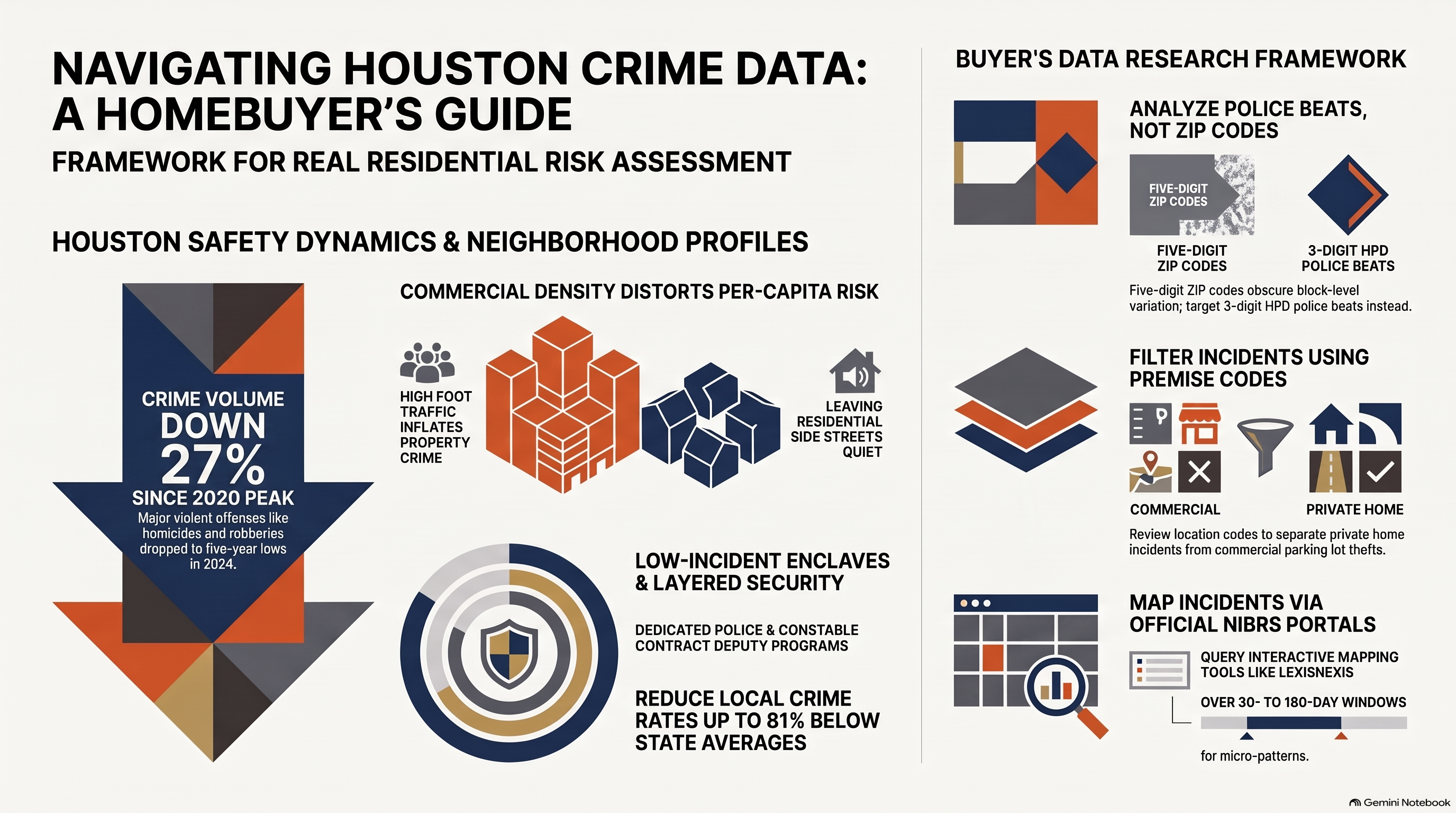
Crime in Houston: What Homebuyers Should Check Before Choosing a Neighborhood
A beautiful house can make you overlook an important question: what will everyday life feel like once you move in?
For Houston homebuyers, neighborhood safety belongs in that conversation. But researching it takes more than typing “safest neighborhoods in Houston” into a search engine and trusting the first ranking. A citywide number cannot explain every residential street, and an old neighborhood list cannot tell you what is happening around a specific home today.
The useful question is more precise: what do reliable, recent records tell you about the area you are considering, and how does that information relate to your own routine?
Start with the address and the reporting agency
Greater Houston is a housing market, not a single police jurisdiction. Before searching for crime information, confirm which agency serves the property. A mailing address, neighborhood nickname, or ZIP code is not enough to establish the reporting boundary.
Houston Police Department resources are a starting point for properties within its coverage. Sugar Land maintains its own official crime-information resources and annual reports. For any other address, identify the relevant municipal police department, sheriff’s office, or other responsible agency.
This distinction matters when an online list mixes Houston neighborhoods, broad directional areas, and separate cities. Those entries may represent different boundaries, populations, reporting systems, and time periods. They should not automatically be treated as comparable.
Do not confuse a ranking with an explanation
A label such as “most dangerous” sounds decisive. Unless the publisher explains its geography, offense definitions, reporting period, and calculation, that label offers little help with an individual purchase.
Ask when the underlying incidents occurred. An article updated recently can still rely on older records. Ask whether the number measures violent offenses, property offenses, all offenses, calls for service, or arrests. Those measures answer different questions.
Also ask whether the statistic is a count, a rate, or an estimate. A large number of reported offenses is not automatically a resident’s personal probability of becoming a victim.
Compare the same crime categories
The original draft compared an overall crime rate with a violent-crime rate. Changing the denominator does not make those categories equivalent. A total that includes theft cannot be used as a direct substitute for a measure limited to violent offenses.
A hypothetical example makes the problem clear: 20 total offenses per 1,000 residents equals 2,000 total offenses per 100,000 residents. That conversion is mathematically correct. It still cannot be fairly ranked against 800 violent offenses per 100,000 residents without acknowledging that the categories differ. These are teaching figures, not Houston statistics.
Use the same offense category, matching time periods, clearly defined geography, and compatible reporting methods before drawing a comparative conclusion.
Read the map in context
A cluster of reports near a shopping center raises different questions from reports along a residential route. Review offense types and location context rather than assuming every dot describes the same exposure.
Police data also has limits. Reported offenses do not capture every crime that occurs. A mapped block is not necessarily an exact location. One incident can involve multiple offenses, so rows of data should not automatically be read as separate victims or separate events.
A quiet-looking map does not guarantee safety. A busy-looking map requires investigation, not an immediate verdict about every person or property nearby.
Use crime research alongside the rest of your due diligence
Before making an offer, look at how the location fits your life. Consider where you park, when you come home, and the routes you use for work, errands, and recreation. Visit at different times when practical. Observe lighting, access, visibility, traffic, and the relationship between the property and surrounding uses.
Keep those observations separate from assumptions about residents. Appearance, price, and school ratings are not proof of a crime pattern. Evaluate schools through their own official information rather than using academic results as a substitute for safety research.
Likewise, do not assume a crime ranking proves a future loss of home value or a particular insurance premium. Review comparable sales and obtain an actual insurance quote for the property. Flood exposure, condition, maintenance, taxes, and affordability deserve their own review.
A practical Houston buyer checklist
First, confirm the exact property and its reporting jurisdiction. Second, open official crime resources and record the actual data coverage dates. Third, separate offense categories and review the surrounding area using a consistent search method. Fourth, examine repeated patterns and relevant routes. Fifth, visit the location, write down unanswered questions, and seek factual clarification from the responsible agency when needed.
Apply that process to every home on your shortlist. Let your own priorities guide the decision, and let evidence support the discussion.
Frequently Asked Questions
What is the most dangerous neighborhood in Houston right now?
This article does not name one. A defensible current ranking requires a defined boundary, matched offense categories, a stated reporting period, and a transparent method. A broad online ranking should not replace research around a specific property.
Where should I start researching Houston crime?
Start by identifying the agency serving the address, then review its official crime resources. HPD publishes crime information for its coverage area; Sugar Land offers separate municipal resources.
Does a crime rate tell me my personal chance of becoming a victim?
Not by itself. An offense count may include repeat incidents, multiple offenses, visitors, businesses, and people with different exposures. Converting it directly into a personal “one in X” risk can be misleading.
Can I compare total crime with violent crime?
You can discuss both, but they are not interchangeable measures. A fair numerical comparison needs matching categories as well as matching time periods and compatible geographic definitions.
Does a low-crime map guarantee that a home is safe?
No. Maps describe the records included in their datasets and the filters selected. Missing reports, reporting delays, and approximate locations limit what they can establish.
Should school ratings determine my safety assessment?
No. Review school performance and suitability separately through official education resources. A school score does not establish whether a particular street meets your safety preferences.
Does higher reported crime prove that a property will lose value?
No. A crime statistic alone cannot establish a future price change or insurance cost. Examine comparable sales, property characteristics, market conditions, and a property-specific insurance quote.
Planning a move in Greater Houston? Contact Vantage Real Estate Group for help organizing your home search and the property-specific questions that deserve answers before you make an offer.
Houston Untold TikTok · Houston Untold YouTube · Houston Untold Instagram · Houston Untold Podcast · Houston Untold Pinterest · Vantage Instagram · (832) 905-9501
Vantage Real Estate Group Powered by PLACE

Michael Flores
Owner/Lead Agent | Vantage Real Estate Group | Keller Williams Signature Realty
or another way